She-ship
On the gender of old boats
This week New Orleans will be graced by the presence of several large, regal ladies. They have names like Esmeralda, Gloria, and Libertad, although Esmeralda sometimes goes by La Dama Blanca. Others have more gender-ambiguous names like Gladan, Unión, or Capitán Miranda.
These are traditional sailing ships (‘tall ships’) that have arrived for a semiquicentennial celebration called Sail 250. New Orleans’s once bustling Mississippi waterfront is the first stop of a traveling maritime festival that will call at several ports along the Atlantic seaboard. Alert residents can watch from the docks as these Grandes Dames arrive in a showy parade of canvas, wood, and wind.
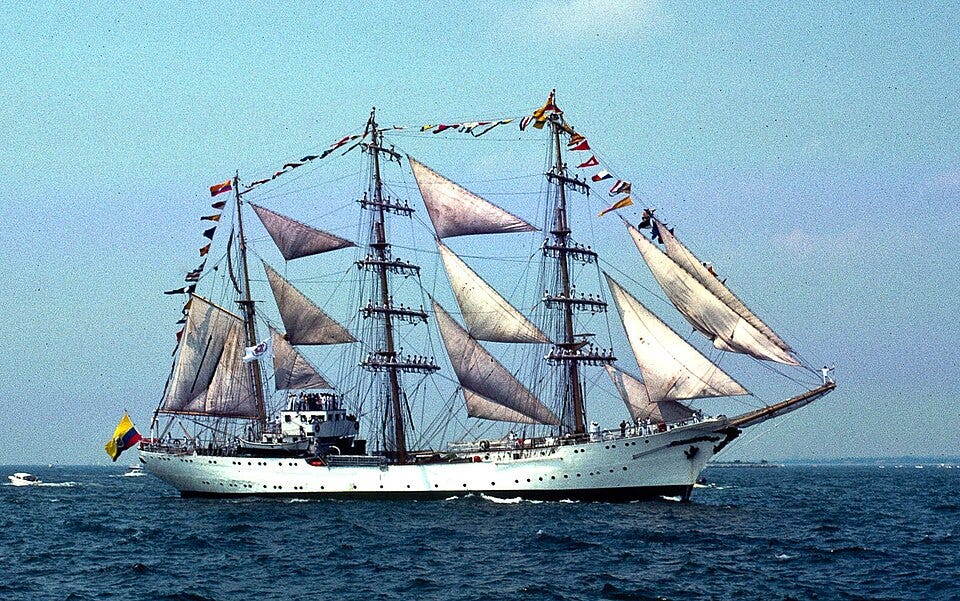
Over the summer, the flotilla will grow, joined by more masculine-sounding ships like the Juan Sebastian de Elcano, F.D. Crockett, Denis Sullivan, and the forceful-sounding Gorch Fock (a German vessel, also a great name for a speed-metal band). Some of them tease with more imaginative names like Fame, Bloodhound, Bluenose II, Belle Poule (pretty ‘chick’), Ticonderoga, or my favorite, the When and If. Whatever their names, most of these ships will be referred to as “she/her” by their crews and admiring mariners.
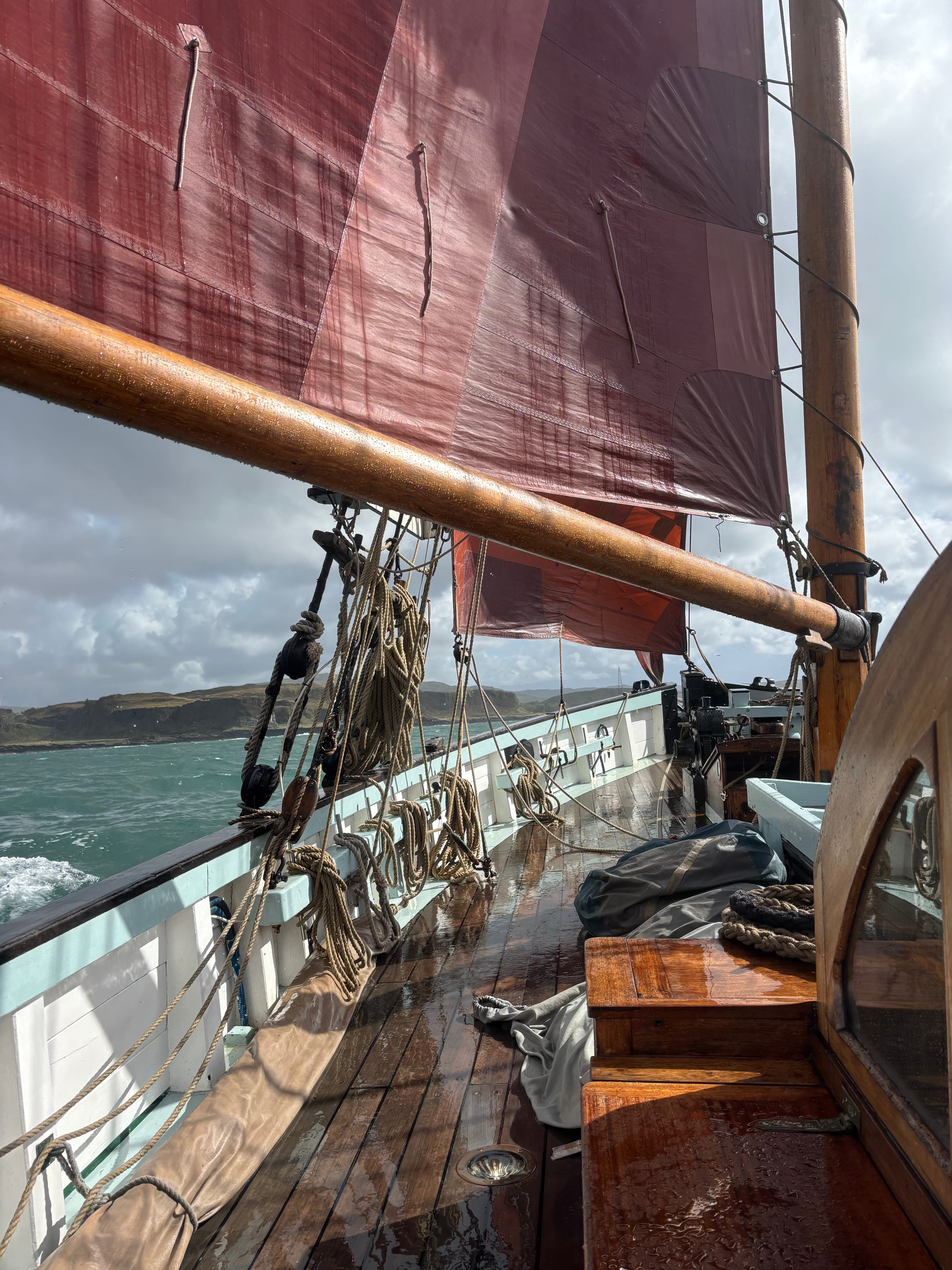
I recently had the privilege of sailing for a week on a 100-year old gaff ketch (iykyk) in the Inner Hebrides. It was my second time signing up for a voyage on Provident. I did it in part because I had felt so well cared for on the boat the first time. Not just by the crew, but by the ship herself. When you sleep, eat, and do other human things below deck while the ship protects you from the unpredictable sea outside, you realize that a ship is less a means of transportation than a form of shelter. I have rarely slept so well as on shipboard, with her rocking, creaking, and soothing scents of old wood. Anchored on a dark night in a protected cove, it can feel like you are back in the womb.
OK, so it is really easy to romanticize sailing. At some point I realized that I had fallen into thinking of Provi (her nickname) as a womanly being. It felt natural. Before getting into sailing, I was neutral on the question of gendering ships, although in my hotheaded youth, I probably would have been offended by all the she-ing.
I will not try to persuade you, gentle reader, if you have a different view. To each their own. ‘She-ship’ works for me, at least for traditional boats. It made me curious about the history of the practice. The earliest recorded instance I could find of a named ship was Praise of the Two Lands, from 2613 BCE Egypt. We don’t know if Praise was a ‘she’, although in Middle Egyptian the word for ship is feminine and ships were associated with the goddess Isis, who was entrusted with protecting sailors at sea.
Some writers claim that our practice derives from the fact that Latin uses navis, a feminine noun, for ship, but that’s a red herring. It doesn’t work for English and Germanic languages with their neuter nouns (Old English was scip, from which we get “skipper”). According to the OED, the earliest known example in English comes from John Barbour’s 1375 history of Robert the Bruce in which a “schip” is referred to as “scho” (she). In Old Norse sagas, ships are identified as female, while the seas are masculine. In Russian, the word корабль (korabl’) is masculine and individual ships are addressed as “he/him.” So feminization, while widespread, is not universal.
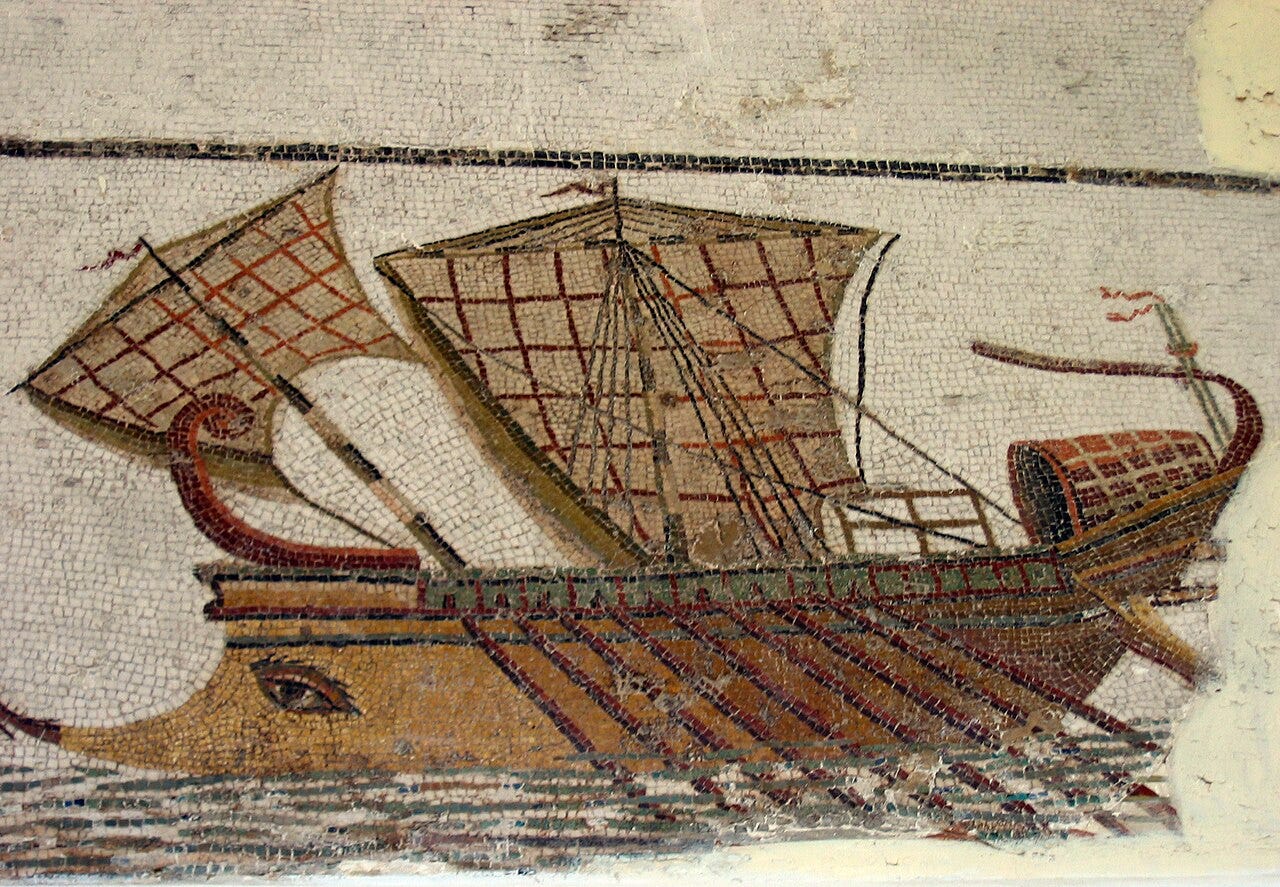
The ancient Greeks and Romans often named their ships after female deities, muses, and virtues. In a remarkable inventory of the Greek war fleet, the Tabulae Curatorum Navalium (c. 379-322 BCE), almost all of the triremes are given feminine names: Pandora, Hebe (goddess of youth), Parthenos (virgin), Aithiopia (African queen), Delphis (girl from Delphi), Hygieia (health), Aura (breeze), and Parrhesia (free speech). The Romans continued the tradition. In a nod to their Egyptian province, they even named one of their grain barges Isis.
In the Christian era, the habit of naming ships after goddesses and feminine abstractions morphed into saints and queens, giving us Columbus’s trio: the Niña, the Pinta, and the Santa María. Well, sort of. According to the Christian Science Monitor, we’ve been lied to. The first two were salty nicknames and the third a whitewash: “La Santa Clara became la Niña (”the girl”); la Pinta became la Pintada (”the painted one,” in other words, “the prostitute”); and la Santa Gallega became Maria Galante (the name of another prostitute). The church censored these nicknames, but the way we remember them today borrows heavily from the crews’ vernacular.”
I was curious whether there had ever been a strongly masc ship. The most famous case is the German battleship Bismarck. Captain Ernst Lindemann, who served in both world wars, insisted on calling the ship a “he,” supposedly to respect its military might and Herr Otto, the “Iron Chancellor.” He ordered his men to refer to the ship using the masculine pronoun on the radio and on board (so “Der Bismarck” rather than “Die Bismarck”). This tactic didn’t save the ship from being sunk by the more gender-fluid HMS Prince of Wales in 1941. The captain went down with his Freund. You’ve probably heard that sailors used to be superstitious about (human) women on a ship bringing bad luck. Maybe it is also risky to misgender your boat.
Ship-naming has not escaped today’s language struggles. In 2002, Lloyd’s List, the eminent London shipping news publication (est. 1734), announced that it would stop using feminine pronouns for ships, switching to “it.” In response, a spokesman for the Royal Navy stated that they would, “continue to call its ships ‘she’ as we always have done. It’s historic and traditional. Ships have a soul.”
In 2019, the Scottish Maritime Museum announced it would refer to ships with gender-neutral terms. They were pressured by anonymous vandals who had scratched out the female pronouns on its signage twice in one year. “We are a charity and our signs are very expensive!” The museum couldn’t win. It then came under fire from retired First Sea Lord and Right Honorable Baron West of Spithead, who called the change “political correctness gone mad… an insult to a generation of sailors. A ship is like a mother.”
The feminist point has been that naming objects largely owned and controlled by men reinforces the objectification of women. I would add that we shouldn’t ignore the fact that over-the-top sexism is itself a maritime tradition. There’s an unattributed saying often found tacked up in wardrooms and common areas on ships that manages to simultaneously insult both human women and old boats. Judging by its sartorial references, it dates to the late 19th century (‘bustle’ provides a terminus ante quem of 1905), but you can still find it today printed on tea-towels sold on Amazon.
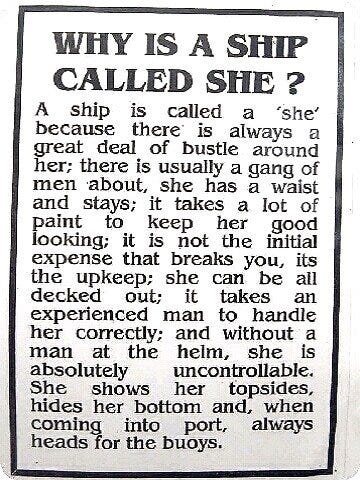
As recently as 1988, retired U.S. rear-admiral Francis D. Foley wrote that men love a ship that is, “slim-waisted, well-stacked, and has an inviting superstructure.” (Speaking of superstructure, there is the related phenomenon of female figureheads, but this topic is fast-blooming into a new series. Stay tuned!)
So the Americans and Spanish see a high-maintenance tart while the Brits see a mother?
In Indonesia, contemporary merchant marines see a ship as a wife. Men who finish duty with a particular ship will refer to themselves as her “widowers.” They say that a ship, “like a woman, needs care and attention to always look beautiful. It also has a certain period of problems or a cycle, such as a docking schedule every 2.5 or five years which should not be ignored.” (!!)
One of the adages of sailing I am starting to appreciate is: ‘”Take care of the ship, and the ship will take care of you.”
When I took the helm of Provident, the skipper told me, “She’s going to go where she wants to go.” I had to respect her inclinations while nudging her towards our target on the horizon and keeping her sails fed with wind. I needed to be gentle but firm. And she was in return. It’s not so much about control as a kind of mutualism.
While women today comprise a tiny percentage of commercial sailors, their ranks in navies and on cruise ships are growing (in the U.S, now around 20%) and women now represent nearly a third of recreational boat buyers in the U.S. and U.K. In some countries, crews on traditional ships are approaching gender parity and an estimated 20% of U.S. tall ship captains are women. The old wooden boats powered by cooperation rather than automation seem to be especially attractive to us.
As more women take to the water, I wonder if they will help retire the old language or will nurture their own relationship with the mother-ship.
If not already, I hope you will consider becoming a subscriber (from free to founder).
It helps the psyche, algorithm, and operating costs! Liking, sharing, commenting also help. Deeply grateful for your support.